
Newz Desk, Durgapur: Three decades ago, India stood on the brink of a technological revolution it could hardly imagine. At a time when pagers were still a novelty and landlines had month-long waiting lists, a single phone call in 1995 quietly changed the nation’s destiny.
A Call That Triggered a Telecom Tsunami
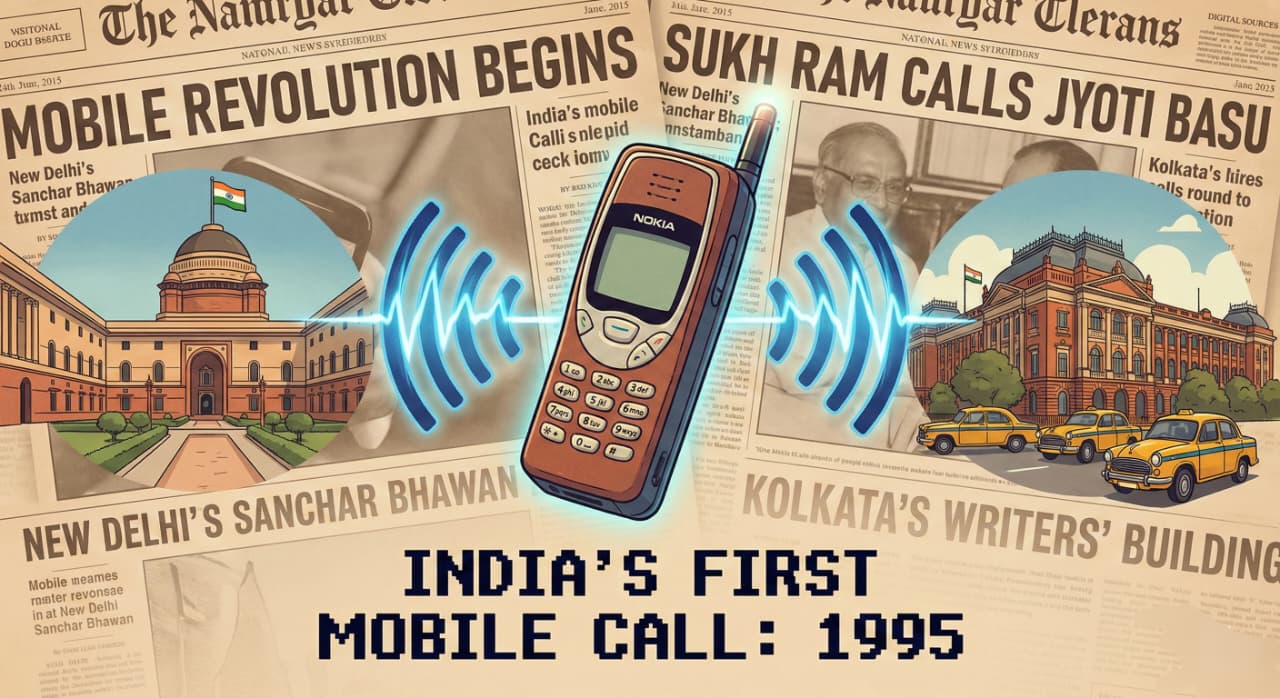
On a historic day in 1995, India’s first GSM mobile call connected New Delhi’s Sanchar Bhawan with Kolkata’s iconic Writers’ Building. Union Telecom Minister Sukh Ram dialed West Bengal Chief Minister Jyoti Basu, marking the moment India officially stepped into the era of mobile telephony.

What appeared to be a ceremonial exchange was, in reality, the spark that ignited one of the world’s fastest-growing telecom markets.
The Unsung Trailblazers
Long before today’s telecom giants dominated India’s digital landscape, the country’s first mobile signal came from Modi Telstra, a collaboration between the B.K. Modi Group and Australia’s Telstra. Of the eight companies licensed to kick-start cellular services, they were the first to go live.
The devices that enabled this historic ‘hello’ were Nokia’s chunky, rugged handsets—heavy by today’s standards but futuristic in the mid-90s, when owning one meant stepping into the elite class.
Why Kolkata Took Centre Stage
Contrary to popular belief, the first mobile service did not begin in Mumbai or Delhi. Kolkata’s network became operational first because of efficient groundwork—mobile towers, switching stations, and GSM infrastructure were completed faster than in other metros.
This placed the City of Joy proudly at the forefront of India’s digital awakening.
A Costly Leap Into the Future
If today’s users complain about data speeds, they would be stunned by the costs of the mobile pioneers. In 1995:
- A handset cost ₹40,000 or more
- Calls were billed on both sides—making and receiving
- Tariffs hovered around ₹8.40 per minute
Owning a mobile phone wasn’t just convenient—it was a statement of wealth and power.
Thirty Years Later: A Nation Transformed
From that single phone call, India has become a nation of over a billion mobile subscribers, with 5G networks, smartphone dependence, and digital connectivity woven into daily life.
What began as a cautious technological experiment in a few metropolitan pockets has now grown into one of the world’s largest and most competitive telecom ecosystems.
A simple “hello” in 1995 didn’t just connect two leaders—it connected India with its own digital future.
Image courtesy@internet