
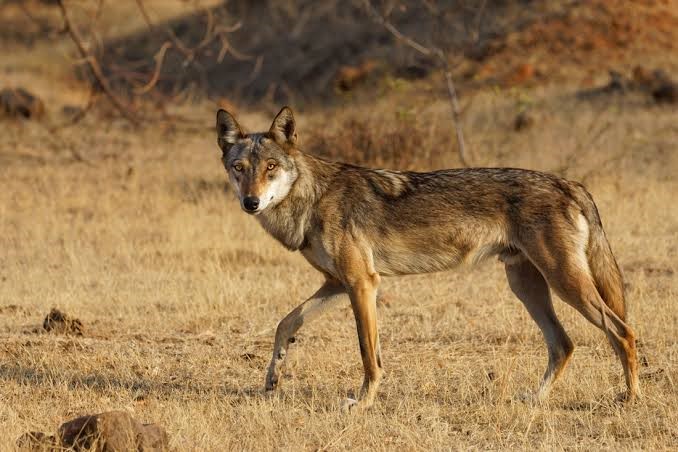
Newz Desk, Durgapur: Bengal’s wildlife researchers have made a striking discovery—an unexpectedly large pack of Indian grey wolves is thriving in the agricultural heartland of East Burdwan. A camera-trap survey currently underway has captured images of 12–15 wolves, marking the first recorded evidence of a sizeable pack in the district.
The findings reflect a notable expansion of the species’ range. Earlier studies conducted between 2023 and 2024 had confirmed the presence of smaller packs—each with no more than six wolves—around Durgapur in West Burdwan’s coal and mining belt.
The new study, led by the Wildlife Information and Nature Guide Society (WINGS) and supported by the Wildlife Conservation Trust’s BEES Grant, is the first ecological assessment dedicated specifically to wolves in East Burdwan. Principal investigator Arkajyoti Mukherjee said the team had identified nearly 500 sq km as potential wolf habitat within the district’s 5,600 sq km area. “The landscape here is very different from the industrial zones of West Burdwan, and early signs point to a healthier, more contiguous habitat,” he said.
Better Forest Cover, Better Support for Wolves
Divisional Forest Officer of the Burdwan division, Sanchita Sharma, said the wolves around Durgapur are often referred to as “urban wolves” because of the region’s industrial setting. “East Burdwan offers better forested areas and more natural conditions, which likely explains why a bigger pack has been recorded so quickly,” she noted.
The project deploys 13 cameras across 45 locations, combining field sign surveys, community questionnaires, and camera-trap monitoring to study distribution, movement, and ecological patterns.
Mapping Movement Corridors
Range Officer Sudip Banerjee said one major aim is to understand how wolves navigate the landscape. Field expert Baharuddin Sk added that the study zone has been divided into 16 sq km grids—each split into four sub-grids—to track distribution more precisely. Earlier research had already shown that at least 30 wolves in four packs use natural corridors to move between West and East Burdwan.
Building a Conservation Baseline
According to field researcher Nayan Kumar, the team is working to establish a baseline understanding of the wolf population in East Burdwan and to identify zones that need priority protection. “Our approach is both population-focused and landscape-focused,” he said.
The study has already identified key wolf habitats, including Debshala, Pratappur, Ausgram, and Valki. The research team also includes experts Anirban Banerjee, Manish Kumar Chattopadhyay, Gourangi Raghav, and Sagar Adhurya.
As the survey continues, the findings are expected to offer crucial insights into how Indian grey wolves adapt across sharply contrasting landscapes—from densely industrialised zones to fertile farmlands—within a single region of Bengal.