


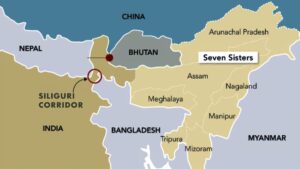
Newz Desk, Durgapur: India has significantly strengthened military security in the Siliguri Corridor—better known as the “Chicken’s Neck”—the country’s narrow and strategically sensitive land link to the Northeast. The move follows growing regional geopolitical concerns and recent shifts in Bangladesh’s defence posture, intelligence sources have indicated.
The corridor, which is crucial for the mobility and safety of nearly 4.5 crore people living in the seven northeastern States, is now being reinforced with new military bases, advanced missile systems and enhanced air-defence measures.
Three New Military Bases Installed Across the Region
According to intelligence officials, three new military bases have been established in Kishanganj (Bihar), Chopra (North Dinajpur, West Bengal) and Dhubri (Assam)—all located around the vulnerable corridor. Each base will host a sizeable contingent of soldiers, with Chopra lying barely one kilometre from the Bangladesh border, enabling faster and more effective surveillance of the frontier.
The security grid now includes Para Special Forces, intelligence units, Rapid Deployment Forces, Rafale fighter jets, BrahMos supersonic cruise missiles and modern air-defence systems.
Geopolitical Concerns Trigger Security Boost
Sources said the decision to tighten security was taken after a controversial statement from Bangladesh’s interim administration raised concerns in New Delhi about Dhaka’s shifting foreign policy.
The situation intensified after developments in Bangladesh’s defence sector following the political transition on August 5, 2024, including:
- Procurement of Chinese J-10C fighter jets
- Proposed supply of JF-17 jets from Pakistan
- Plans to scale up indigenous drone manufacturing
These changes have prompted India to strengthen its strategic preparedness around one of its most sensitive geographical chokepoints.
Rafale and BrahMos Deployment to Act as Deterrents
Defence experts said the presence of Rafale fighters and BrahMos missiles around the corridor significantly boosts India’s deterrent capabilities. Any attempt to disrupt or blockade the corridor could severely affect military mobility; the new bases have been designed to ensure rapid deployment of troops and equipment during emergencies.
“Chicken’s Neck is not just a geographical strip—it is the lifeline of India’s strategic future,” said a security analyst. “Its security will always remain India’s top priority.”
Successful BrahMos Test in Bay of Bengal
In a parallel development, India successfully tested an upgraded version of the BrahMos supersonic cruise missile in the Bay of Bengal on Monday. The test was conducted jointly by the Army’s Southern Command BrahMos unit and the Andaman & Nicobar Command.
The missile demonstrated excellence in range performance, trajectory precision, high-speed stability and target accuracy, defence sources said.
The test also carries strategic weight following global attention on BrahMos after India’s recent precision strike during Operation Sindhur. India has extended the missile’s range from 290 km to 400 km and has set a target to reach 800 km. Work is underway to transition the system from supersonic to hypersonic technology.
Experts said the successful trial not only marks technological progress but also sends a strong message about India’s growing maritime and military preparedness—something that adversarial nations “cannot ignore”.
Image courtesy@internet